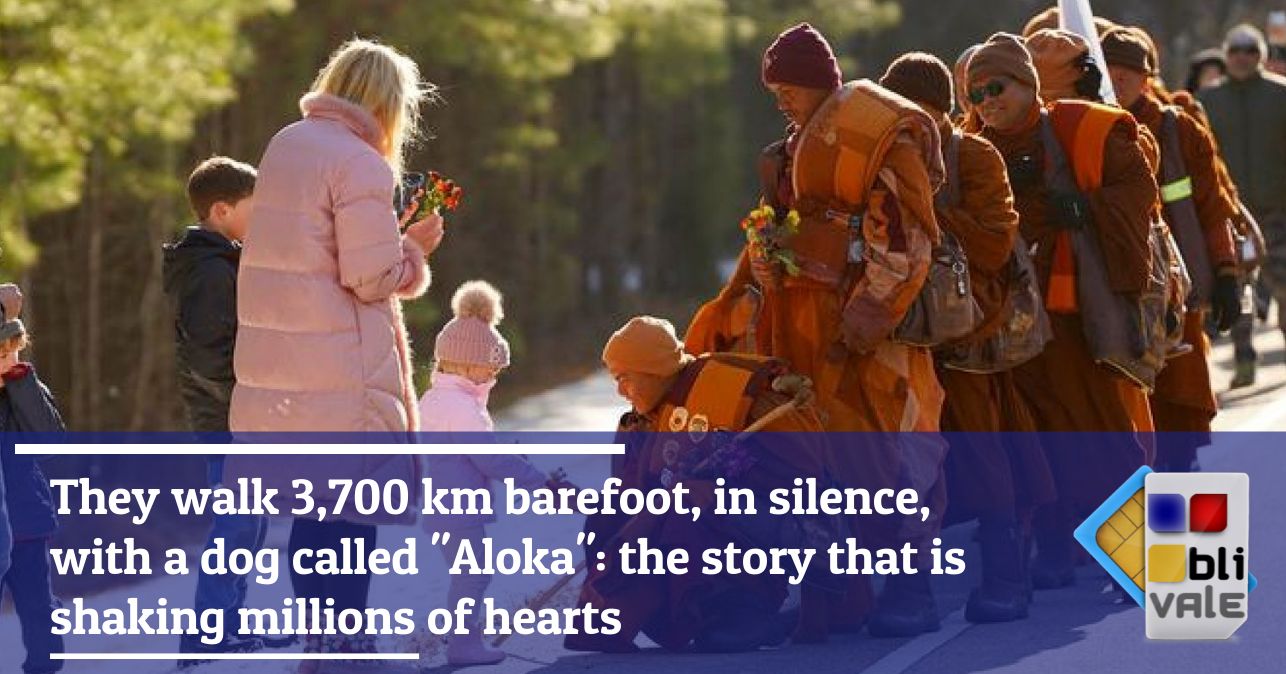
They walk 3,700 km barefoot, in silence, with a dog called "Aloka": the story that is shaking millions of hearts... and that should make anyone who has ever traveled, or has ever believed that progress is born only from conflict, reflect.
It's February 4, 2026. Day 102. Outside there's dirty snow, freezing wind, American highways that seem to never end.
A group of 19 Theravada Buddhist monks (many of Vietnamese origin, led by Venerable Bhikkhu Paññākāra) walk in single file, slowly, determinedly. Saffron robes against the gray winter. Often bare feet on the asphalt. No megaphones. No signs. No insults.
Trotting beside them is Aloka , the stray dog they adopted along the way. His name means "light"/"enlightenment" in Pali. He has unwittingly become one of the most recognizable faces of 2026.
Leaving on October 26, 2025, from the small Huong Dao Vipassana Bhavana temple in Fort Worth, Texas, they decided to do what today seems almost impossible: walk 2,300 miles (3,700 km) to Washington, D.C. Just to walk. Just to be present. Just to remember that peace is not a political slogan, but a daily practice of silence and concrete kindness.
In just a few days—most likely Tuesday, February 10, 2026 —they will arrive on the Capitol lawn. There, they will deliver a message of collective healing and formally submit a request to recognize Vesak (Buddha's Day) as a federal holiday in the United States.
This isn't a protest. It's a silent earthquake in a world that screams 24/7.
In an age dominated by polarization, cancel culture, viral insults, culture wars, and toxic news, these monks do exactly the opposite.
They offer presence . They offer silence . They offer handmade bracelets and, only if someone asks, simple words of compassion.
And millions of people stop. Silent 15-second reels go viral: feet touching the asphalt, Aloka wagging his tail, a hand offering hot tea, a gentle bow to a tearful stranger.
The comments are all the same:
“I turned off my phone and cried for ten minutes.” “This is the only content that doesn’t make me angry.” “Thank you for reminding me that there’s still good out there.” “I wish I had the courage to walk even a part of the way with them.”
They went through hell without stopping
On November 19, 2025, a truck hit their support vehicle. A monk lost a leg. The group could have stopped everything. They continued. The injured monk, after months in the hospital and rehabilitation, rejoined them. He still walks with them.
Aloka himself underwent cruciate ligament surgery, recovered, and was able to walk again. Then, to be safe, in recent weeks he traveled more frequently in the support van to rest. But his spirit remained with them.
Ordinary people respond with ordinary gestures: churches opening their doors at night, families with thermoses of hot chocolate, elderly people coming out onto their porches with emotion, children handing out paper peace cranes.
But why does almost no “important” person openly march with them?
There have been many concrete gestures:
Christian churches (Methodist, Episcopal, some Catholic and Baptist) that host them
shepherds and faithful walking a few miles together
Washington National Cathedral officially included in the program
mayors handing over keys to the city
governors (Texas, North Carolina, Virginia with Abigail Spanberger on February 2) signing “Walk for Peace Day” proclamations
individual senators (like Raphael Warnock) who meet them and post heartfelt messages
Yet there is no major national/international endorsement: no bishops' conference, no major evangelical denomination, no leading Islamic/Jewish/Hindu organization, no joint statement from the White House or Congress.
Why? Because this march isn't against anyone. It doesn't generate useful anger. It offers no clear enemies. It doesn't lend itself to becoming the banner of a political or religious faction. It's too clean. Too universal. Too inconvenient for those who thrive on polarization and internal priorities.
And this very purity is its greatest strength: true peace doesn't need megaphones, sponsors, or paid likes. It exists anyway.
Is peace unnatural? Or have we simply been told the wrong story?
There is a very harsh narrative: that man progresses only through conflict, that war is the mother of all inventions, that without violence there is no evolution.
False.
Cooperation (not aggression) was the true evolutionary superpower of Homo sapiens
Per capita violence has decreased enormously over the millennia
The brightest, most creative and enduring periods in human history have been those of relative stability and peace :
Pax Romana (~27 BC – 180 AD): 200 years of relative stability → roads, aqueducts, Roman law, Virgil, Ovid
Pax Britannica (1815–1914): trade and stability → Industrial Revolution, railways, telegraph, modern medicine, abolition of slavery in much of the world
Long Peace from 1945 to today: no wars between great powers → computers, internet, mRNA vaccines, mobile telephony, genetics, AI, historic collapse of extreme poverty, doubled life expectancy
War accelerates the application of existing ideas (radar, mass-produced penicillin, jets, ARPANET) because it brings enormous resources and urgency. But fundamental discoveries almost always arise in civilian contexts, in times of peace. And above all: war destroys human, economic, and cultural resources. The same investments in civilian research would have produced greater progress—with infinitely less suffering.
Because this story speaks straight to the hearts of those who travel (and those who make real travel possible)
The monks walk 3,700 km, relying almost exclusively on the kindness of strangers. They don't have perfect Plan Bs. They don't have endless batteries. In many places, they don't even have shoes.
And yet they continue. One step at a time.
When we travel, we want to know only one thing: that we can stay connected .
Connected to those we love when homesickness strikes. Connected to work that doesn't wait. Connected to a map when we're lost. Connected to a song that keeps us company in the rain.
Traveling without worries doesn't mean eliminating all uncertainty. It means knowing that, no matter what happens, you'll always have an open line back home, to yourself, to the world.
BLIVALE exists exactly for this:
to give you the most reliable connection possible,
so you can afford the luxury of turning off your mind…
and listen only to your footsteps, your breathing, your path — internal and external.
Because the most beautiful journey is not the one you take furthest.
That's what you make most present .
These monks are reminding us all of this, one step at a time.
And we at BLIVALE just want to make sure that wherever your path takes you—physical, emotional, spiritual—you're never alone.
Walk calmly. We're here.