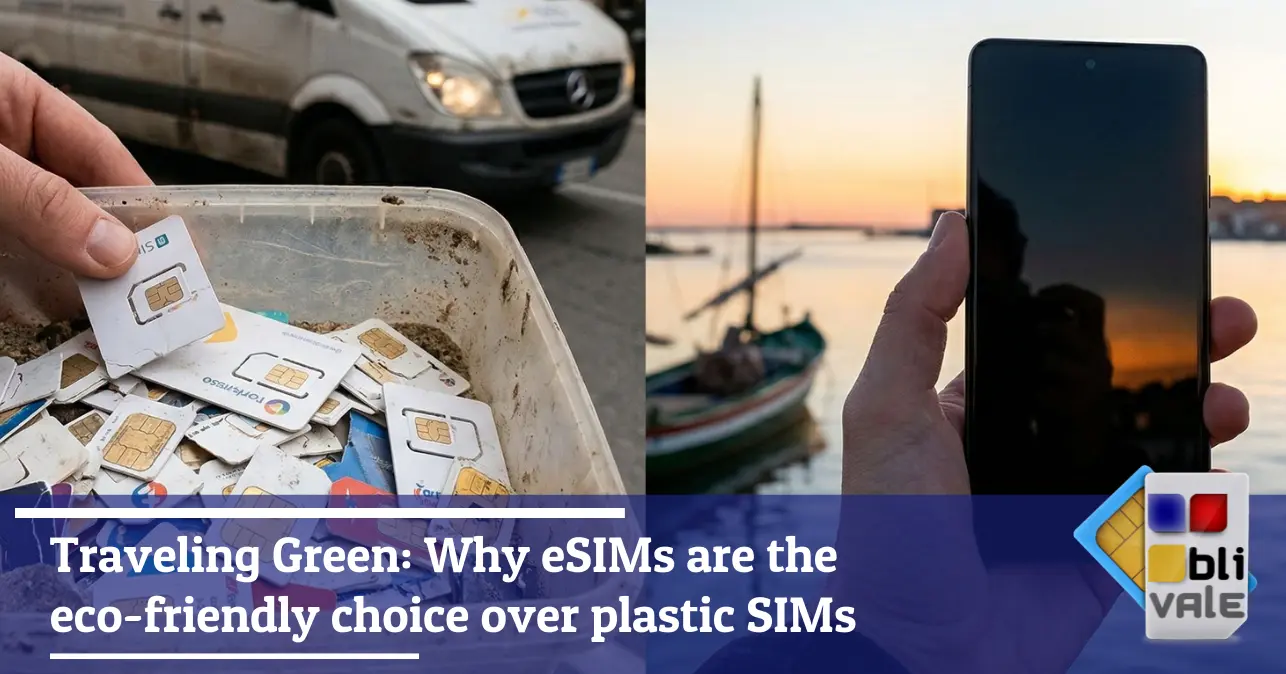
An in-depth analysis of the environmental impact of traditional SIM cards and how digital dematerialisation is reshaping the way we connect to the world.
"Over 10 billion physical SIM cards are circulating on the planet. It's time to make our connectivity invisible to the environment."
The invisible weight of a tiny piece of plastic
How much plastic do you carry in your wallet when you travel? We tend to focus on avoiding straws or single-use bottles, yet we overlook a small object we always have with us: the SIM card. In 2025 alone, billions of these PVC supports were manufactured. When you add the plastic of the SIM itself to that of its outer casing — the credit-card-sized tray you throw away immediately — it becomes clear that traditional connectivity carries a silent but enormous environmental cost.
Individually, a SIM card weighs almost nothing. Yet, aggregated on a global scale, they represent tonnes of plastic waste, unrecovered precious metals and polluting logistics cycles. In 2026, technology offers us a concrete way out: total dematerialisation.
Switching to eSIM is not just a technical upgrade for your smartphone — it's the first step towards making every trip a genuinely low-impact experience.
From extraction to disposal: an ungreen journey
To truly understand the impact of a traditional SIM card, we need to follow it through its entire existence. Each phase reveals an environmental cost that is often underestimated:
Production requires PVC derived from hydrocarbons, silicon extracted through energy-intensive processes, and traces of gold and copper for the electrical contacts.
SIM cards are mounted on credit-card-sized plastic carriers: 90% of the packaging material is discarded by the consumer within seconds of opening.
Physical distribution — across warehouses, couriers, shops and airports — generates CO₂ emissions that accumulate throughout the entire global supply chain.
Added to these three stages is the final disposal: most SIM cards are not sorted correctly and end up in general waste, ruling out any chance of recovering the rare metals present in the chip.
eSIM: The revolution that takes up no space
The eSIM — or embedded SIM — is a permanent chip soldered inside the device, remotely programmable via a simple digital protocol. The carrier profile is downloaded over the network: no courier, no plastic wrap, no newly extracted metal.
Cloud Connectivity: connectivity as a pure service
The key concept is dematerialisation: connectivity ceases to be a physical object and becomes information. This paradigm shift brings structural environmental benefits:
- Zero additional extraction — the eSIM chip is manufactured once for the entire lifetime of the device, with no need for new physical supports for each data plan.
- Zero packaging — no blister pack, no cardboard, no plastic wrap to dispose of.
- Zero waste from changing operator — switching plan or country is a purely software operation, generating no physical waste.
It's a technology that solves the problem at the root, rather than merely optimising an already-polluting process.
The connectivity of the future has no shape, no weight, leaves no trace. eSIM is not just a different chip: it's a different philosophy of consumption.
From order to activation without moving a single van
Consider the typical journey of a physical SIM card purchased abroad: from a factory in Asia to a European warehouse, then to a national distributor, then to an airport retailer or local shop. Every step involves packaging, transport, emissions.
Activating an eSIM data plan means scanning a QR code received by email. The entire transaction — from request to use — can happen in under two minutes, consuming a few kilobytes of data and zero fossil fuel.
The concrete CO₂ saving per activation
Even by eliminating just the "last mile" stage — home delivery or a trip to the shop — the saving is tangible. Considering the full supply chain of a physical SIM, the emissions differential between the two models becomes significant at the scale of millions of users.
For the frequent traveller, the difference multiplies: each destination traditionally requires a new local SIM. With eSIM, the same physical chip manages dozens of digital profiles, eliminating dozens of production and logistics cycles.
Physical SIM vs eSIM: A sustainability analysis
A comparative summary of the main environmental impact factors between the two technological models:
| Impact Factor | Traditional SIM Card | eSIM Technology |
|---|---|---|
| Plastic materials | PVC and single-use packaging | Zero |
| E-Waste | High — SIMs discarded after use | Zero additional waste |
| Logistics emissions | Physical air/road shipping | Digital transmission |
| Longevity | Subject to wear and loss | Permanent in the device |
| Changing operator | New physical SIM required | Software operation |
| Packaging | 90% discarded immediately | None |
Small actions for a big change
The transition to more sustainable connectivity requires no sacrifices — just conscious choices. Here is a concrete checklist for the eco-aware traveller:
- 1 Choose entirely digital connectivity providers. Selecting operators that distribute plans exclusively via eSIM eliminates the entire physical logistics chain at source.
- 2 Avoid buying disposable SIM cards at airports. These single-use prepaid SIMs are among the most polluting: short lifecycle, maximum production and disposal impact.
- 3 Recycle old smartphones correctly (e-waste). The digital sustainability chain also includes device end-of-life: WEEE collection points ensure recovery of rare metals.
- 4 Choose devices with sustainability certifications. Brands that document the use of recycled materials and low-emission manufacturing processes complete the picture of responsible technology consumption.
FAQ: Everything you want to know about eSIM and sustainability
Travelling in 2026: A commitment to a connected planet
Technology carries a responsibility that goes beyond function. Every tool we use leaves a footprint — on the places we visit, the resources we consume, the air we breathe at every destination.
Choosing digital connectivity is not simply a matter of technical convenience: it is an act of integrity towards the destinations we love to explore. A small step in gesture, but significant in systemic logic.
The future of connection is light and invisible. It leaves no plastic in the oceans, fills no drawers with unused chips, burns no fuel to deliver us a rectangle of PVC. It is already here, embedded in the devices we carry in our pockets. We just need to choose it.