Work from anywhere — but not on just any connection
"Is there Wi-Fi?" has become the most important question of every trip.
We used to look for a central location or a breakfast included. Today, for those who have chosen the freedom of international remote work, the fundamental criterion is network latency. Being able to send a heavy project from a terrace in Lisbon, join a company meeting from a café in Bangkok, or deliver a prototype from a coworking space in Bali is no longer a pipe dream — but it depends almost entirely on the quality of the connection available.
The dream of digital nomadism can turn into a nightmare in minutes: all it takes is a shaky Wi-Fi during a crucial client call, an upload that stalls halfway through, or a VPN that can't establish itself on unreliable networks. Geographic freedom, in its most concrete form, depends on a single factor that's often invisible: the quality of the network.
In this guide we explore the 5 destinations that in 2026 offer the best balance between the beauty of the place and the power of the digital infrastructure — where data speed meets quality of life. If you're planning your next "office with a view", you're in the right place.
Top 5 Destinations for Digital Nomads in 2026
The following selection is not based on subjective impressions. Every city was evaluated against objective criteria: average connection speed in Mbps, monthly cost of living for a professional, perceived safety, density of coworking spaces, and the presence of an active international community. Here are the five places that truly delivered in 2026.
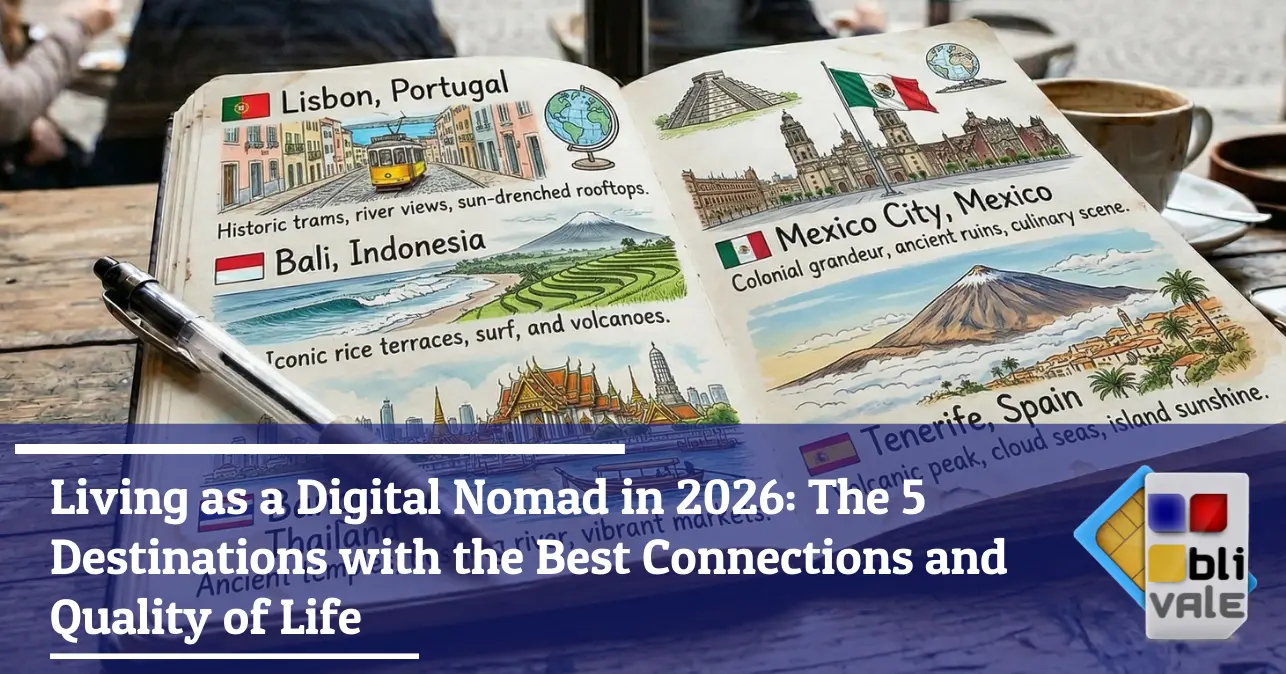
1 Lisbon, Portugal — Europe's Tech Capital
Lisbon has been Europe's digital nomad capital for years, and in 2026 it consolidates its lead. The city hosts Web Summit, one of the world's largest tech events, and has become the benchmark for startups, freelancers and remote workers from every corner of the globe. The international community is vast, quality coworking spaces are spread across every neighbourhood — from Príncipe Real to LX Factory — and average fixed-line connectivity exceeds 150 Mbps.
Portugal has introduced one of the most generous digital nomad visas in Europe, with streamlined procedures and preferential tax regimes for those who can demonstrate remote work income. Add the mild climate, extraordinary food and a rich social life, and it's easy to see why Lisbon keeps topping every ranking.
2 Canggu, Bali (Indonesia) — 5G Among the Rice Fields
Bali is more than beaches and temples. Canggu has become the world capital of tropical coworking, with dozens of fully equipped spaces, pools included, cafés with guaranteed upload speeds and a unique creative energy. The technological leap of recent years has been remarkable: 5G coverage is expanding rapidly across urban areas, bringing speeds of 50 to 100 Mbps even outside the city centre.
The cost of living remains among the lowest on this list: it's entirely possible to live well on €1,200–1,500 per month, rent a villa with a private pool, and have access to every type of digital service. That said, watch out for occasional power outages and monsoon rains that can affect the network — a local SIM or a backup eSIM are indispensable tools.
3 Bangkok, Thailand — Record-Breaking Speed at Virtually No Cost
Bangkok is probably the biggest surprise for those who haven't yet discovered it as a nomad base. The Thai capital offers one of the best internet infrastructures in all of Asia: average speeds exceeding 200 Mbps, fibre optic widely deployed, and an ecosystem of coworking spaces and ultra-tech cafés that is hard to match anywhere in the world — all at an exceptionally low cost of living.
You can live very well on €1,000–1,300 per month in a modern apartment, eating quality food at laughably low prices. The city is a permanent laboratory of urban innovation: efficient public transport, digital districts like Ekkamai and Ari, and a young, hyper-connected population that makes the environment genuinely stimulating. The only variables: heat and air quality, which during certain seasons require some adjustment.
4 Mexico City (CDMX) — Fibre Optic and American Time Zones
Over the past two years, Mexico City has exploded as the go-to destination for American and European digital nomads alike. The reason is as simple as it is strategic: the time zone aligns perfectly with the North American market, fibre optic is present in every residential neighbourhood with speeds exceeding 100 Mbps, and costs are significantly lower than any city in the United States or Canada.
Neighbourhoods like Roma Norte, Condesa and Polanco host a thriving ecosystem of design-forward coworking spaces, laptop-friendly cafés, and a world-class cultural and gastronomic scene. The temperate climate at 2,240 metres above sea level is a welcome advantage over the tropical heat of other destinations. CDMX has definitively joined the elite tier of remote work cities.
5 Tenerife, Spain — Eternal Spring with EU Standards
Tenerife is the smartest choice for those who want to leave continental Europe without losing its advantages. Part of Spain — and therefore the European Union — the island offers European-grade telecoms infrastructure with average speeds exceeding 100 Mbps, zero EU roaming restrictions, and a familiar legal and fiscal framework. Temperatures hover between 22–25°C year-round, which is why it's known as the "island of eternal spring."
The Canary Islands have introduced specific tax incentives for remote work (ZECSE), making them even more attractive. The digital nomad community is growing rapidly, especially in the areas of Santa Cruz and Puerto de la Cruz. For anyone with doubts about safety or bureaucracy — there are none here: you're working within the EU, with all the guarantees that entails.
Don't leave it to chance: the Technical Survival Kit
Knowing where to go is only half the battle. The other half is how to prepare so that connectivity never becomes the bottleneck of your productivity. Here are the unwritten rules of every seasoned digital nomad.
Test the network before you book. Sites like Speedtest.net and Nomad List aggregate real-world speed data by city and neighbourhood, often with reviews from fellow remote workers. Before confirming an accommodation, search these platforms, read the recent reviews, and don't hesitate to ask the host for a live speed test.
Never rely solely on the hotel or coworking Wi-Fi. Shared networks are inherently unstable: they slow down during peak hours, can drop without warning, and above all they expose your data to significant security risks — especially on open, passwordless networks. A missed meeting or an unsent file can cost you a contract.
Also consider using a reliable VPN to protect your communications on public networks — essential if you handle sensitive client data or access corporate systems. Keep in mind: a VPN works properly only on stable connections, so the quality of your base network remains the primary factor.
Comparison: Speed, Costs and Key Strengths
A quick-reference overview to help you navigate the five destinations at a glance. Speed data refers to aggregated averages on fixed and mobile networks in areas with a high density of digital nomads.
| Destination | Avg Speed | Cost of Living | Key Strengths |
|---|---|---|---|
| 🇵🇹 Lisbon | 150+ Mbps | Medium | Community, Startups, Nomad Visa |
| 🇮🇩 Bali (Canggu) | 50–100 Mbps | Low | Lifestyle, Coworking, Cost |
| 🇹🇭 Bangkok | 200+ Mbps | Very Low | Ultra-fast infrastructure, Cost |
| 🇲🇽 Mexico City | 100+ Mbps | Medium/Low | Time zone, Culture, Gastronomy |
| 🇪🇸 Tenerife | 100+ Mbps | Medium | Climate, EU Safety, Tax incentives |
Note: speed data is indicative and may vary by neighbourhood, accommodation type and time of day. Always verify real-world connectivity before relying on aggregated statistics.
Beyond Gigabytes: visas, permits and incentives for digital nomads
One of the least explored — but most important — aspects of international remote work is the legal dimension. Working as a "tourist" in a foreign country can expose you to bureaucratic or tax complications, especially if your stay extends beyond 90 days.
The good news is that over the past three years there has been an explosion of dedicated digital nomad visas around the world. Beyond Portugal, countries like Spain (with its "Digital Nomad Visa"), Indonesia (with the KITAS B211A), Mexico (temporary residency permits), Croatia, Georgia, Albania and Costa Rica have all introduced streamlined procedures for those who can demonstrate a remote work income, typically from a minimum monthly threshold.
The practical benefit is twofold: on one hand you avoid any legal risk, and on the other, certain regimes — such as those in the Canary Islands or Georgia — offer significantly more favourable income tax rates than the European average. Consulting an accountant or international tax advisor before relocating is always the most prudent and cost-effective long-term decision.
FAQ — Questions from the Modern Nomad
What is the minimum internet speed needed to work remotely without problems?
How do I protect my data in coworking spaces and on public networks?
Can I legally work as a tourist in another country?
What happens if the connection drops during an important call?
Choose your next desk
Digital nomadism is not a passing trend: it is a profound redefinition of the relationship between work, space and identity. In 2026, the world's technological infrastructure has reached a level that makes possible what seemed utopian just a few years ago: working with the same efficiency from a villa in Bali, an apartment in Lisbon or a café in the heart of Mexico City.
The key is simple but often overlooked: connection quality is not a detail to check upon arrival — it's the primary criterion on which every destination choice should be based. The five destinations in this guide were not selected for the beauty of the views (though that's there too), but for their capacity to support a real, ambitious, growing career.
Choose carefully where you take your laptop. Plan your connection before your flight. And remember that the most absolute geographic freedom always has one concrete prerequisite: being always online, wherever you are.
Connectivity for Professionals
Next time you're in transit or travelling, don't leave your connection to chance.
International connectivity solutions exist designed exactly for professionals like you — activatable in 2 minutes, operational in over 200 countries, with no long-term contracts.
Explore connectivity solutions →