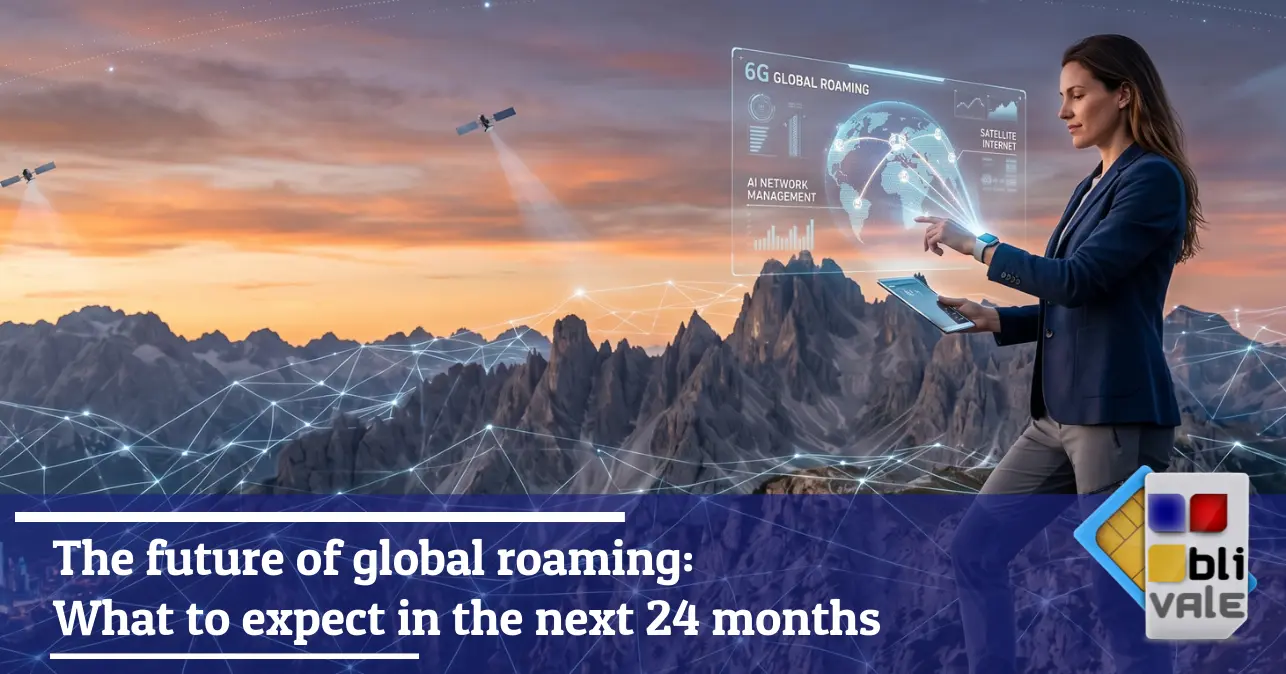
The future of global roaming: What to expect in the next 24 months
From AI integration to the 6G revolution: the strategic roadmap for today's and tomorrow's leaders.
Connectivity landscape outlook for 2027
2027 will not simply be a year of greater speed — it will be the year of "Resilient Connectivity". For Managers and Decision Makers, the ability to access corporate data while roaming will no longer be an option, but a fundamental requirement for operational continuity. Companies that embrace these technologies will ensure their teams can participate in critical decision-making processes wherever they are, eliminating the gap between the office and global mobility.
According to market projections, roaming data traffic will grow at a compound annual growth rate (CAGR) of 25%, driven by the need for stable connections for remote work and augmented reality. We are not talking about incremental improvements, but a paradigm shift: the transition from a network that "responds" to a network that "anticipates". By the end of 2027, the concept of "searching for a signal" will be a thing of the past.
6G vs 5G: What are the real benefits?
While 5G continues its global expansion, 2026 will mark the official start of public testing for 6G technology (expected for standard commercialisation around 2030). But be aware: this is not just about "downloading files faster". The heart of 6G is the reduction of latency to near-zero levels (micro-latency).
| Feature | 5G (Current) | 6G (Projected) |
|---|---|---|
| Peak speed | Up to 20 Gbps | Up to 1 Terabit/s |
| Latency | ~1-5 milliseconds | Below 0.1 ms (Micro-latency) |
| Reliability | High | Extreme (Medical/industrial use) |
| AI integration | Application layer | Native (AI at the core of the network) |
What does this mean for business? Imagine simultaneous AI translation during an international negotiation, as fluid and natural as an in-person conversation, or the ability to manage critical infrastructure via "Digital Twins" in real time from another continent. 6G will not just be about faster movie downloads — it will enable "Holographic Communication" and the "Internet of Senses", where network response is so fast it enables tactile feedback at a distance.
Hardware & Prototypes: When will we see the first devices?
Today, 6G testing is confined to laboratory infrastructure in China, South Korea, and Finland (with the 6Genesis project). The first hardware prototypes — from Terahertz modems to new integrated sensors — will begin to appear not only in infrastructure, but as advanced modules for high-end smartphones and tablets. The timeline for the end user is already mapped out:
- 2026 – Consumer Prototype Phase: We will see the first modular modems unveiled at major events (CES, MWC), capable of handling Terahertz (THz) frequencies. These will not yet appear in commercial smartphones, but in developer kits for businesses.
- 2027 – Accessories and Smartwatches: The first "6G-ready" wearables will begin to emerge as advanced prototypes, focused on centimetre-level geolocation precision (rather than metre-level).
- Smartphones and Tablets: While Apple and Samsung chips will begin integrating pre-positioned hardware components in 2027, the first fully compatible smartphones will not reach the mass market before the end of the decade. In the meantime, the next 24 months will see an explosion of devices featuring second-generation integrated satellite modems.
The role of AI and 6G in business processes
From 2026 onwards, Artificial Intelligence will firmly establish itself within organisations, becoming the invisible operating system of administrative processes. Here, 6G becomes the essential catalyst:
- Ultra-Secure Cloud Connection: Instant access to corporate ERP and Cloud databases without slowdowns, enabling decisions based on data updated to the millisecond.
- Immersive Video Conferencing: Virtual meetings will transition from 2D to holographic or extended reality (XR), requiring the stability and bandwidth that only the synergy between AI and 6G can deliver.
- Decision Automation: AI while roaming will be able to analyse complex reports during travel, suggesting the best administrative action directly on your smartwatch or tablet.
Satellite-cellular connectivity: The end of dead zones
The integration of NTN (Non-Terrestrial Networks) and terrestrial cellular networks will definitively eliminate dead zones. The convergence of ground-based networks and LEO (Low Earth Orbit) satellites will become the industry standard within the next 24 months. This "network of networks" ensures that an executive on assignment in remote areas or a technician on an offshore platform remains always connected.
Thanks to partnerships between innovative providers and LEO satellite constellations, a smartphone will be able to switch from an urban 5G cell to a satellite connection in the middle of the ocean in under 2 seconds, without any interruption to the data session.
The impact: Roaming will extend to where traditional towers cannot reach. In the middle of the ocean or in the desert, signal continuity will be absolute. This means total safety for employees and constant availability for management.
Intelligent Routing (AI)
Devices in the near future will use AI not only for the user, but for the network itself. Intelligent routing will select the operator or connection type (5G, 6G-proto or Satellite) based on app priority. By analysing the rates of hundreds of operators in real time and cross-referencing them with usage habits (e.g. heavy MS Teams use vs light scrolling), the algorithm will choose the most cost-effective and high-performing data route, reducing hidden costs by 30-40% compared to current standard plans.
Practical example: If the system detects the start of a Zoom or Teams call, the AI will give absolute bandwidth priority to that stream — sacrificing background updates or social media if necessary — selecting the most stable available signal within milliseconds.
Hyper-personalised data plans: The Pay-per-App model
We will witness the end of generic, inefficient "flat" plans. The future lies in granular cost control through "pay-per-app" models. Companies will be able to purchase specific packages: "Unlimited Zoom" for travelling employees, "Priority Cloud Access" for system administrators, or "Social Media Only" for the marketing department.
This enables surgical management of telecommunications budgets, eliminating waste and maximising operational efficiency.
Frequently Asked Questions for Management
Beyond borders: Connectivity as universal freedom
In a world accelerating towards automation and ubiquitous intelligence, global roaming is ceasing to be a mere technical service and evolving into a natural extension of our decision-making capacity. The next 24 months will bring not only faster networks, but the definitive end of "disconnection". Whether it is a manager coordinating an acquisition in real time via cloud from the desert, or a young professional shaping their office among alpine peaks, the synergy between 6G, AI and satellite networks will make data access as simple and invisible as the air we breathe.
The true revolution will not lie in the technology we hold in our hands, but in the freedom it grants us: the freedom to act, decide and create without the barrier of a border or a dead zone. We stand at the dawn of an era in which physical distance has been definitively overcome by digital continuity. The future is not something that will happen — it is a connection we are already living.