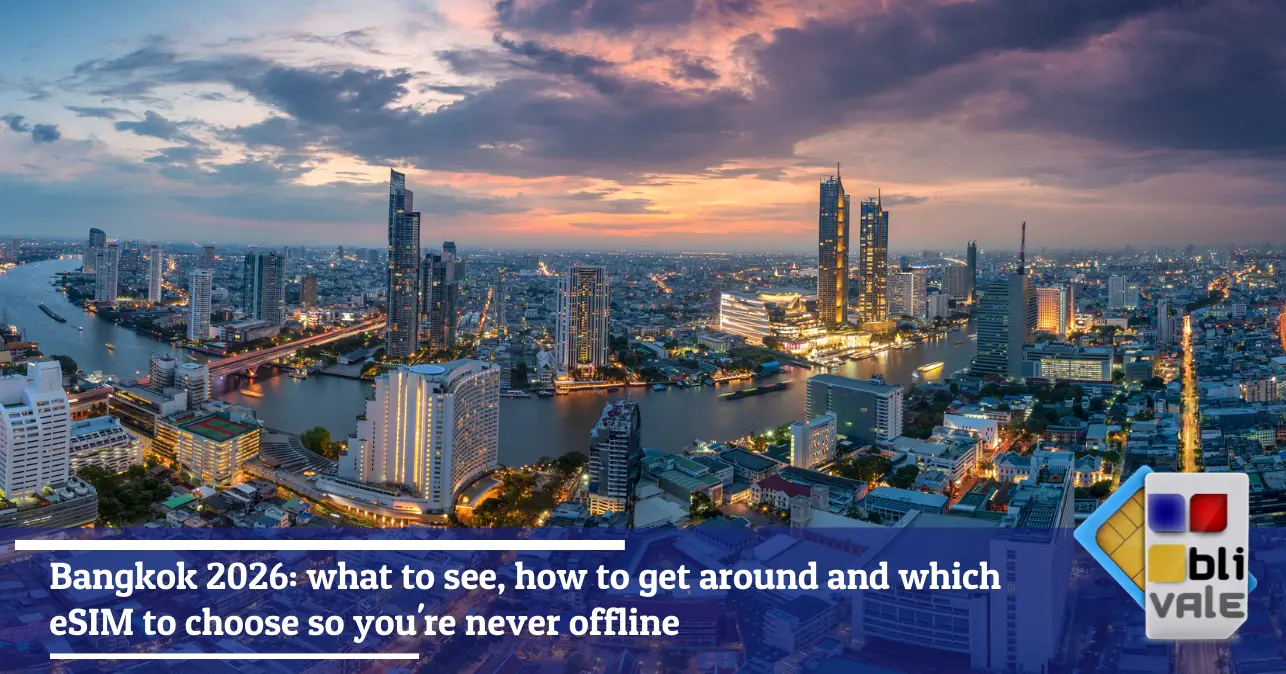
Bangkok 2026: what to see, how to get around and which eSIM to choose so you're never offline
Over thirty million international travellers in a single year: Bangkok is the most visited city in the world, and it's no accident. But even here you can get lost, pay three times the going rate for a tuk-tuk and, if you haven't prepared, end up without data just when you need the map. This guide brings together what to see, how to get around, what to know before you leave and how to stay connected, with figures and prices checked in October 2026.
Bangkok by the numbers: why it's the most visited city in the world
In 2025 Bangkok welcomed 30.3 million international visitors. That figure earns it first place in Euromonitor International's Top 100 City Destinations ranking, ahead of Hong Kong (23.2 million) and London (22.7 million). The same top 10 also includes Macao, Istanbul, Dubai, Mecca, Antalya, Paris and Kuala Lumpur.
To give you a sense of scale: that's on average over 80,000 international arrivals a day, in a single city. If you've ever felt like just another tourist in front of the Grand Palace, you were right. But there's a reason so many people come back: Bangkok manages to bring together temples, markets, street food, nightlife and huge shopping malls without making you travel hundreds of kilometres.
The figure of 30.3 million refers to international arrivals in 2025 according to Euromonitor. Other rankings, such as Mastercard's index of overnight visitors, use different methodologies and can return different numbers. Bangkok's lead, however, has been confirmed for years by several surveys.
Why it's worth going (and when)
The most concrete reason is the variety of experiences in one place. In a single week you can go from the golden temples of the old city to the skyscrapers of Silom, from a street food stall to an air-conditioned mall. And you can do it on any budget: the city offers hospitality and food for every wallet, from a plate of street food to a luxury hotel.
There's also a logistical factor that is often underestimated: Bangkok is the natural starting point for the rest of the country. From here you can reach the southern islands, the north with Chiang Mai and, as a day trip, the ancient capital of Ayutthaya. With a single base you can build a long trip.
The right season: November to February, with a caveat
The most comfortable period is November to February, the driest and relatively coolest season. Relatively: “cool”, in Bangkok, is a word to be taken with a pinch of salt.
| Period | What to expect | Best for |
|---|---|---|
| November-February | Very little rain. In December and January average highs are around 31-32 °C and lows around 23-24 °C | Anyone who wants to walk between temples and markets with less effort. It is also the most in-demand period |
| March-April | The hottest period: in April average highs are around 35 °C, with high humidity | Anyone who doesn't fear the heat and plans early-morning visits and breaks indoors |
| May-October | Rainy season, peaking in September. Downpours are often heavy but tend to be concentrated in certain hours | Anyone who accepts a few surprises in exchange for a less crowded city |
Life in Bangkok: pace, heat and neighbourhoods
Bangkok has an intense rhythm. The traffic is that of an enormous metropolis, the heat is humid and the city is lived mostly outdoors: you eat in the street, shop in the markets, take the boat to cross the river. The nice thing is that all of this coexists with an ultra-modern Bangkok.
- The modern areas. Sukhumvit and Silom are the areas of skyscrapers, hotels, shopping centres and evening life. They are also among the best served by the elevated metro.
- The historic neighbourhoods. The Rattanakosin area, the old city on the Chao Phraya river, concentrates the royal palace and the main temples. There the pace slows down, though the crowds don't.
- Chinatown. In the evening it turns into a long corridor of street food, among the most photographed (and tasted) things in the city.
In big cities and tourist areas the main risk is petty crime: pickpocketing, scams and misleading directions from self-styled guides. A few simple rules are enough: agree the tuk-tuk price before you get in, be wary of anyone who tells you the temple is “closed today”, and keep your bag and phone in front of you in crowded places.
What to see: the five stops you can't miss
Bangkok has hundreds of things to see, but if it's your first time these five tell the story of the city well. The first three are close to each other, so it's best to put them on the same day.
| Stop | What it is | Practical info |
|---|---|---|
| Grand Palace and Wat Phra Kaew | The royal palace and the Temple of the Emerald Buddha | 500 baht for foreigners. Last entry at 15:30. Strict dress code |
| Wat Pho | The temple of the Reclining Buddha, 46 metres long | About 300 baht. About a 10-minute walk from the Grand Palace |
| Wat Arun | The Temple of Dawn, on the Chao Phraya river | About 200 baht. Reached by ferry from Tha Tien |
| Chatuchak Market | The big weekend market | BTS Mo Chit, or MRT Chatuchak Park or Kamphaeng Phet |
| Chinatown (Yaowarat) | The Chinese quarter and its evening street food | Can be reached from the Ratchawongse pier on the tourist boat |
Grand Palace and Wat Phra Kaew: the historic heart
The Grand Palace dates from 1782, when King Rama I founded the Chakri dynasty, and it is Thailand's most revered royal complex. Inside it is Wat Phra Kaew, the temple that houses the Emerald Buddha. The ticket costs 500 baht for foreigners (about €13 at the current exchange rate) and includes access to some museums in the complex, such as the Queen Sirikit Museum of Textiles. Opening hours are normally 8:30-16:30, with last ticket sales at 15:30.
Two tips from someone who has been: arrive at opening time, because it is the city's most visited attraction, and dress properly. The dress code is genuinely enforced and shoulders and knees must be covered. Allow between an hour and a half and two and a half hours for the visit.
Wat Pho: the Reclining Buddha
It is one of the largest temple complexes in the city and houses a Reclining Buddha covered in gold leaf, 46 metres long and 15 metres high. When you see it you understand why it looks “squeezed” into the hall. Wat Pho is also considered the cradle of traditional Thai massage: if your feet are in pieces after the Grand Palace, it is the most fitting place to get put back together. Admission costs about 300 baht, with indicative opening hours from 8:00 to 18:30.
Wat Arun: the temple on the river
The Temple of Dawn stands on the Thonburi bank, on the other side of the river. Its central tower rises above 70 metres and dominates the riverbank. To get there you cross the Chao Phraya by ferry from the Tha Tien pier, which costs a few baht and is already a small experience in itself. Admission is about 200 baht.
Chatuchak: the weekend market
Chatuchak is Thailand's largest weekend market and one of the biggest in the world: the most quoted estimates speak of over 15,000 stalls spread over 27 sections, with clothing, crafts, ceramics, furniture, plants, books and a huge food area. The main days are Saturday and Sunday; some sections open on Friday evening and the plants even midweek. Hours vary by section, so check before you go. By BTS get off at Mo Chit, by MRT at Chatuchak Park or Kamphaeng Phet.
Chinatown: the city at dinner
If Bangkok has a right hour, for many it is the one after sunset in Chinatown, among signs, grill smoke and tables that spill onto the carriageway. Here the evening street food is the real reason to go: arrive hungry, taste a little of many things and favour the stalls where you see turnover and a queue of locals.
One day in temple Bangkok: a realistic itinerary
To avoid wasting time on pointless transfers, here is a sequence that works and is based on the real timings of the stops.
- Early morning, Grand Palace. Arrive at the 8:30 opening to avoid the worst of the queues. Give it at least an hour and a half.
- Late morning, Wat Pho. From the royal palace it's about a 10-minute walk. Plan one to one and a half hours and, if you like, a massage.
- Lunch break in the area. The heat makes itself felt: drink plenty and eat something in the shade before setting off again.
- Afternoon, Wat Arun. From the Tha Tien pier, ferry to the other side of the river.
- Evening, Chinatown. By tourist boat or public transport, for a street food dinner.
The second day can be devoted to Chatuchak (if it falls on a weekend) and the third to the modern districts of Sukhumvit and Silom. With three or four days you can see the main stops well; with five to seven you can also add a day trip out of the city.
How to get around: BTS, MRT, boats and taxis
Bangkok's traffic has a well-deserved reputation. For this reason, whenever possible, it is worth choosing the transport that doesn't get stuck in it.
BTS Skytrain: the elevated metro
It is the most convenient network for the modern areas. It has two lines, Sukhumvit and Silom, and some stations are particularly useful for travellers: Siam (the main interchange, close to the big shopping centres), Asok (connection with the MRT), Sala Daeng (for Silom), Saphan Taksin (for the river piers), Mo Chit (for Chatuchak) and Phaya Thai (connection with the Airport Rail Link to Suvarnabhumi airport). Fares run indicatively from 17 to 65 baht depending on distance.
MRT: the underground
It is run by a different operator from the BTS, which is why the two networks have different cards. On the Blue Line rides cost indicatively from 17 to 45 baht. It is especially useful for reaching Chatuchak and the old city area: Sanam Chai station is close to Wat Pho.
The river: boats and ferries
The Chao Phraya is Bangkok's old highway and very often beats the road for speed and pleasure. There are two ways to use it. The Express boat stops at many piers with fares of a few tens of baht. The blue-flag tourist boat stops at the main piers with commentary in English and has a hop-on hop-off day ticket for about 150 baht. Its piers include Sathorn (linked to the Saphan Taksin BTS), ICONSIAM, Ratchawongse (Chinatown), Wat Arun, Tha Chang (Grand Palace) and Phra Arthit (Khao San area).
Taxis, tuk-tuks and apps
For routes that public transport doesn't reach, taxis and apps like Grab are the simplest choice: the address is already set and you don't have to haggle. The tuk-tuk remains an experience to try at least once, but agree the price and the duration before setting off. Near the temples the traffic is notoriously heavy: sometimes the boat is faster.
From the airport into town
Bangkok has two international airports: Suvarnabhumi (BKK) and Don Mueang (DMK). From Suvarnabhumi the Airport Rail Link runs to Phaya Thai, where you change to the BTS. Always check which of the two your flight lands at before organising the transfer.
Cards and passes: what's really worth it (transport and museums)
In Bangkok there is no single card that does everything. The system is made up of separate cards, and the thing that surprises most people is that the BTS card is not valid on the MRT.
| Transport | Card or ticket | Good to know |
|---|---|---|
| BTS Skytrain | Rechargeable Rabbit Card, single ticket or day pass | The Rabbit Card is bought at the ticket office; your passport may be requested. Initial cost and deposit vary: check at the station |
| MRT | Dedicated rechargeable card | A separate network from the BTS. According to local guides, since August 2025 there is the Mangmoom Card, an integrated card for the MRT lines |
| Express boat | Single ticket, paid at the pier or on board | No card: keep a few coins and small banknotes handy |
| Tourist boat (blue flag) | Single ride or hop-on hop-off day ticket (about 150 baht) | Worth it if you make at least three stops on the same day |
| Museums and attractions | Single tickets | As far as we know there is no official combined pass. The Grand Palace ticket does, however, include some museums in the complex |
One card for the BTS, one for the MRT, cash for the boats, single tickets for the attractions. Prices and conditions change often: always check fares at the station and on official sites before buying for several days.
Before you leave: entry rules for Thailand in 2026
Here is a novelty that many guides haven't picked up yet, and which could throw your travel plans off. From 15 September 2026 the old 60-day visa exemption, introduced in July 2024, is gone. In its place there is a 30-day exemption for citizens of around sixty countries and territories, including the member states of the European Union. For some nationalities the duration is different and the visa on arrival has been greatly scaled back; some countries that previously qualified for 60 days now require a visa. The full list should be checked with the Thai embassy in your country before you book.
- Passport with at least 6 months' remaining validity from entry and in good condition.
- Up to 30 days for tourism: no visa, if your nationality is covered by the exemption. Beyond 30 days, or if you are not on the list, you need a visa or an e-Visa to be requested before departure on the official portal thaievisa.go.th; the exemption can be extended only once by 30 days at an immigration office, at the officer's discretion.
- TDAC: the Thailand Digital Arrival Card is mandatory, free and must be completed online on the official site tdac.immigration.go.th within the 72 hours before arrival. Beware of sites that charge for it.
- Onward ticket out of the country within the permitted length of stay: it isn't always checked, but it may be requested.
- Travel insurance: not compulsory for tourism, but strongly recommended.
Entry rules can change again: before you leave, always check with the Thai embassy in your country and the travel advice of your foreign ministry.
Why in Bangkok connectivity matters more than you think
Think about it for a moment. The TDAC gave you a QR code to show on arrival. The Grand Palace can be booked online up to a month in advance. To avoid traffic and haggling, you use an app to call a taxi. To find your way between piers and stations you need a map. To understand a menu written in Thai, a translator. And to write to the people waiting at home, WhatsApp.
In a big, chaotic city like Bangkok, being left without data is no small annoyance: it is the moment you are standing in front of a street you don't know, with a phone that loads nothing. The classic alternatives all have their limits: roaming on your home operator's plan can cost a lot, while a local SIM requires finding a shop as soon as you land, usually with an ID document.
The eSIM solves exactly this point: you buy it before you leave, install it calmly from home or at the airport and, at the right moment, you're already connected, with no physical SIM to swap.
BLIVALE Thailand Unlimited eSIM: what it includes and how much it costs
The BLIVALE Thailand Unlimited eSIM offers a truly unlimited internet connection across Thailand, relying on the main local partner networks: TrueMove, DTAC and AIS. It is a premium profile that applies no Fair Usage Policy (FUP) and no speed limits, with browsing on 3G, 4G/LTE and 5G and a guaranteed minimum speed of 10 Mbps (which may vary depending on local coverage or network congestion).
- Hotspot included, to share the connection with PCs, tablets and other phones.
- No contract and no ID document to provide.
- Support for all apps: WhatsApp, Teams, Zoom and GPS navigation.
- Duration in calendar days; the high-speed threshold resets at midnight UTC, which in Thailand (UTC+7) corresponds to 07:00 in the morning.
- Personalised QR code by email within 1-4 hours of purchase: don't wait until the last minute.
Bangkok, but also the whole country
The purchase links below refer to the country and not the city, but for you it is the same thing: the eSIM can be used in Bangkok and also throughout Thailand. If from Bangkok you set off on an excursion to the north, to the islands or on a trip to Ayutthaya, the connection follows you. In terms of continuity it is a big advantage: one profile, no reconfiguration when you change stop.
Prices and direct checkout links
We have selected five durations designed for the most common trips. The daily cost stays almost identical (between about €1.94 and €1.98 a day), so choose the duration based on your itinerary.
| Duration | Price | Average cost per day | Designed for | Checkout |
|---|---|---|---|---|
| 7 days | €13.70 | about €1.96 | A Bangkok city break | Buy 7 days |
| 10 days | €19.70 | about €1.97 | Bangkok plus one excursion | Buy 10 days |
| 15 days | €29.70 | about €1.98 | Bangkok, the north or the islands | Buy 15 days |
| 20 days | €38.70 | about €1.94 | A long trip with several stops | Buy 20 days |
| 30 days | €58.70 | about €1.96 | Maximum visa-free stay | Buy 30 days |
If you are looking for a different duration, going directly to the product page you will also find alternatives from 1 to 30 days. A useful detail: for those covered by the exemption the visa-free stay is 30 days, so the 30-day plan covers the entire maximum period.
Unlimited refers to data, not coverage: the signal always depends on the local operators' networks. In Bangkok, where coverage is widespread, the difference is felt above all in peace of mind: you can use maps, video, tethering and video calls without watching a counter.
When activation starts: the detail that changes your days
A point that is often discovered too late: when you install the QR code, activation starts immediately. The days of use begin to run from that moment, not from when you land or turn on data.
If you install the eSIM the day before departure or on the same day, to complete the installation you need an active internet connection (home, hotel or airport Wi-Fi). Remember too that the QR code arrives by email within 1-4 hours of purchase: plan with a little margin.
In practice: buy in advance, install calmly when you have Wi-Fi available and bear in mind that the day count starts from that moment.
Hotspot and a real number: two advantages for those who don't travel alone
The BLIVALE Unlimited Premium and BLIVALE Unlimited Smart eSIMs have the hotspot included, so they are suitable for all travellers with multiple devices, for families and for anyone who shares the connection with tablets and computers.
Most of the other eSIMs also offer the hotspot; however, if you plan to use it intensively, Unlimited Premium eSIMs from BLIVALE are recommended.
BLIVALE provides eSIMs with a real mobile number to use for calls and SMS in the country, in the region or globally. The number can also be used to receive OTP codes and to sign up for apps such as WhatsApp, where virtual numbers are not accepted.
How much data you really use: a real case in Thailand
“But how many gigs do I need?” is the question everyone asks and nobody answers with an honest number, because it depends on how you use your phone. To give you a concrete reference we looked at the usage data of a BLIVALE Thailand Unlimited eSIM over the period from 22 to 30 May 2026, taken from the monitoring panel.
Daily consumption in GB, Thailand Unlimited eSIM (22-30 May 2026)
* Partial days (on 22 May the first record is at 06:20, on 30 May the last at 14:38). Days calculated on UTC time, as in the monitoring panel; 1 GB = 1,000 MB.
The chart tells you something that GB-based plans don't let you see: consumption is not steady. There are light days, around 1.3-1.7 GB, and days when traffic shoots up: on 29 May it exceeded 10 GB, and in some individual hourly records about 2.5 GB was reached. With a plan of just a few gigs, days like that would have emptied everything in a few hours.
This is a real usage example, not an average valid for everyone and not a promise of consumption. The panel indicates a delay of 4-8 hours in displaying the details and reports times in UTC. We don't know which apps generated the traffic: the data only shows how much usage can vary when there is no cap to respect.
Checklist before leaving for Bangkok
Let's put it all in order, in the sequence in which it's best to do it.
- Check that your passport has at least 6 months of remaining validity and is in good condition.
- Check whether your nationality is covered by the 30-day exemption in force since 15 September 2026, otherwise apply for a visa.
- Complete the TDAC on the official site within the 72 hours before arrival and save the QR code as a screenshot.
- Have an onward ticket out of the country and travel insurance ready.
- Check that your phone supports eSIM and is not locked to an operator.
- Buy the eSIM in advance: the QR code arrives by email within 1-4 hours.
- Install the eSIM on Wi-Fi, remembering that the days start immediately.
- Download offline maps and save addresses and bookings, including those for the Grand Palace.
- Prepare clothing suitable for temples: shoulders and knees covered.
- Bring cash in small denominations for boats, markets and street food.
Frequently asked questions (FAQ)
Is Bangkok really the most visited city in the world?
According to the Euromonitor International Top 100 City Destinations ranking, in 2025 Bangkok was the most visited city in the world with 30.3 million international visitors, ahead of Hong Kong (23.2 million) and London (22.7 million). Other rankings, such as those based only on overnight visitors, use different methodologies and may give different figures.
What is the best time to visit Bangkok?
The driest and coolest season runs from November to February: in December and January the highs are around 31-32 degrees and the lows around 23-24, with very little rain. April is the hottest month, with average highs around 35 degrees, while the rainy season runs from May to October, peaking in September.
Do I need a visa to go to Thailand?
Since 15 September 2026, citizens of around sixty countries and territories, including the member states of the European Union, can enter for tourism without a visa for up to 30 days; the old 60-day exemption is no longer in force, and for some nationalities the duration is different. For longer stays, for purposes other than tourism, or if your nationality is not on the list, you need a visa or an e-Visa requested before departure. The full list should be checked with the Thai embassy in your country.
What is the TDAC and how do I fill it in?
The Thailand Digital Arrival Card (TDAC) is the online arrival declaration, mandatory since 1 May 2025 for all foreigners entering Thailand, and it replaced the paper TM6 form. It is free, must be completed on the official Immigration Bureau website within the 72 hours before arrival and generates a QR code to show at border control: it is worth saving it as a screenshot too.
How much does the Grand Palace cost and what are its opening hours?
The ticket for foreigners costs 500 baht and includes Wat Phra Kaew, the Temple of the Emerald Buddha, and access to some museums in the complex. The complex is normally open from 8:30 to 16:30, with last ticket sales at 15:30. The dress code is strict: shoulders and knees must be covered. Prices and hours may change, so they should be checked on the official website.
Is there a single pass for museums and transport in Bangkok?
As far as we know, no: there is no official combined pass covering museums and public transport. You pay single tickets for the attractions, while for transport you use different rechargeable cards: the Rabbit Card for the BTS and a dedicated card for the MRT. For the boats on the Chao Phraya there is a hop-on hop-off day ticket of about 150 baht on the blue-flag tourist boat.
Does the BLIVALE Thailand Unlimited eSIM only work in Bangkok?
No. The purchase links refer to the country, not the city: the eSIM can be used in Bangkok and also across Thailand, for example if you leave Bangkok for excursions to the north or the islands. It relies on the main local partner networks (TrueMove, DTAC and AIS).
How many days of eSIM should I choose?
For this BLIVALE eSIM the 7, 10, 15, 20 and 30-day durations are available, at €13.70, €19.70, €29.70, €38.70 and €58.70 respectively. By going directly to the product page you will also find alternatives from 1 to 30 days. Since the visa-free stay is 30 days, the 30-day plan covers the entire maximum period.
When do the days of use of the eSIM start?
Activation starts immediately, the moment you install the QR code: the days of use begin from that instant. If you install the eSIM the day before departure or on the same day you need an internet connection (Wi-Fi) to complete the installation. The duration of the plan is calculated in calendar days.
After purchase, how long does the QR code take to arrive?
The personalised QR code is sent by email within 1-4 hours of purchase. For this reason it is best to buy a little in advance rather than at the last minute, and to install the eSIM when you have Wi-Fi available.
Does the Unlimited eSIM have a hotspot?
Yes. The BLIVALE Unlimited Premium and Unlimited Smart eSIMs have the hotspot included, so they are suitable for those travelling with several devices and for families. Most of the other eSIMs also offer the hotspot, but for intensive use the Unlimited Premium ones are recommended.
Can I receive calls, SMS and OTP codes with a travel eSIM?
With a normal data-only eSIM, no. BLIVALE, however, provides eSIMs with a real mobile number, to use for calls and SMS in the country, in the region or globally. The number can also be used to receive OTPs and to sign up for apps such as WhatsApp, where virtual numbers are not accepted.
How much data do you really use in Thailand?
It depends a lot on how you use your phone. In a real case of a BLIVALE Thailand Unlimited eSIM monitored from 22 to 30 May 2026, total traffic was about 31.6 GB, with an average of about 3.5 GB a day and a peak of about 10.3 GB on a single day. It is an example of use, not an average valid for everyone.
Conclusions
Bangkok is one of those cities you can love or struggle to digest, often on the same day. But the 30.3 million visitors of 2025 show that the formula works: temples that take your breath away, endless markets, food everywhere, a transport network that with a little practice becomes simple.
The most useful advice, though, is the least touristy one: sort out the boring things before you leave. Entry and TDAC, transport cards, clothes for the temples and connectivity. With a BLIVALE Unlimited eSIM you get continuity of connection and genuinely unlimited data in Bangkok and across Thailand, and if you also need a number for OTPs, calls and SMS, there is the eSIM with a real number. The rest is the beauty of travel: getting lost in a Chinatown alley with a charged phone and a network that holds.
Next time you're in transit or travelling, don't be left without a connection.
International connectivity solutions exist designed precisely for travellers and professionals: activated in 2 minutes, working in over 200 countries, with no long-term contracts.
Notes and references: the figure of 30.3 million international visitors comes from the Top 100 City Destinations ranking by Euromonitor International (year 2025). The entry rules for Thailand reported are those in force since 15 September 2026 and should be checked with official channels (the Thai Immigration Bureau, the Thai embassy and your own country's foreign ministry). Prices in baht, opening hours and transport fares are indicative, checked in October 2026 on public sources, and may change without notice. Consumption data comes from the monitoring panel of a BLIVALE Thailand Unlimited eSIM; product information comes from BLIVALE's public documentation.