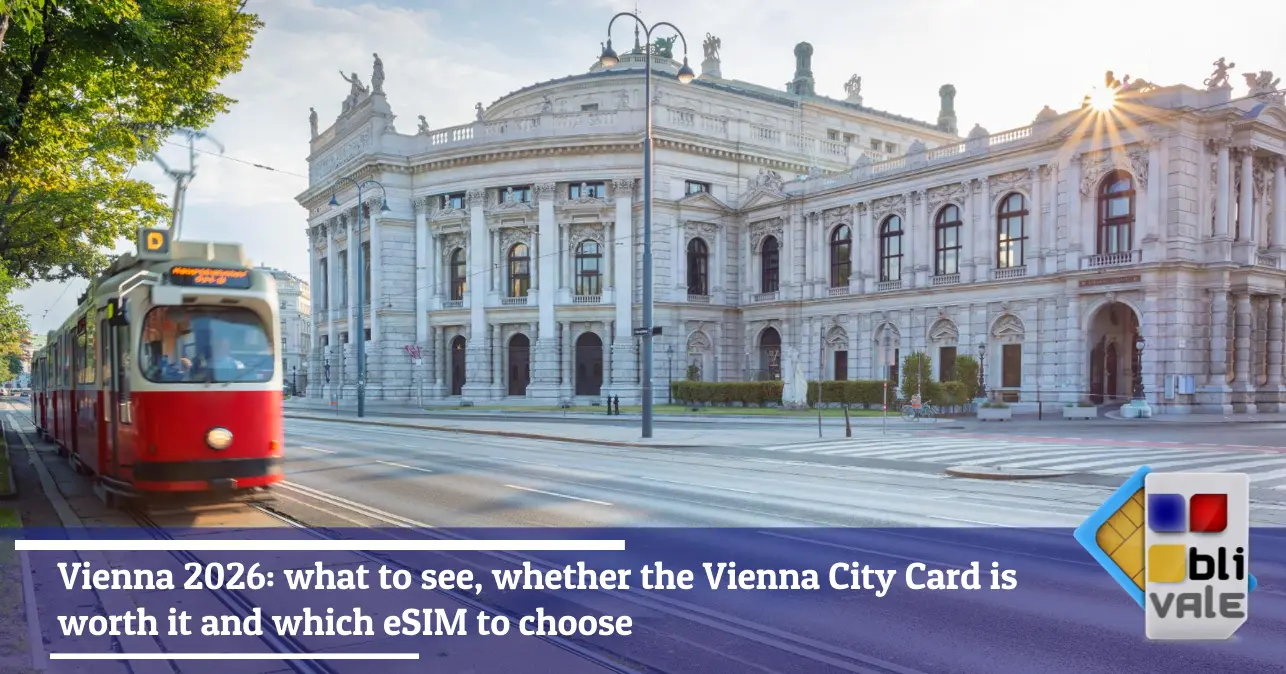
Vienna 2026: what to see, whether the Vienna City Card is worth it and which eSIM to choose
A historic café, an imperial palace, an evening at the Opera: it is easy to fall for Vienna. But the practical details make the difference, and in 2026 some of them are new: the 48- and 72-hour public transport tickets are gone, the railway to the airport is under works until the end of October 2027 and the Christmas market opens in just a few days. This guide brings together what to see, how to get around, when the Vienna City Card is really worth it and how to stay connected, with prices and rules checked on 1 November 2026.
Vienna in numbers: a record-breaking imperial capital
Vienna can be described in three words: palaces, music and cafés. And the formula works. Industry estimates put international arrivals at about 6.63 million a year, and the official figures from the city's tourist board tell of a record 2025: 8.57 million guests staying overnight and 20.07 million nights spent in the city, up 5% and 6% respectively on 2024. It is the first time Vienna has passed 20 million overnight stays, and the strongest month of the year was December, thanks to the Christmas markets.
In travel terms: Vienna is very popular, but it does not feel suffocating. It is an orderly capital with efficient transport, where you can go from imperial palace to museum, and from museum to café, without crossing half the city by car.
Figures depend on what is being counted. The 6.63 million is an estimate of international arrivals; the 8.57 million published by Vienna's tourist board covers all guests who stayed overnight in the city in 2025, including Austrian visitors. They are two different measures of the same reality: use the first to compare Vienna with other cities worldwide, the second to understand how “full” the city is of tourists over a year.
Why visit (and when)
The most concrete reason is the density of things to see in a small space. The old town, the Innere Stadt, can be walked; the rest is covered by U-Bahn, trams and buses on the same ticket. Add the cultural side: opera, concerts, world-class museums, historic cafés. It is a city that rewards those who travel out of interest, not just for photos.
There is also a second reason that is often underestimated: Vienna is a handy base for day trips to other Austrian destinations, such as the Wachau valley on the Danube. And if you go at the end of the year, it is one of the European capitals where Christmas is best enjoyed.
When to go: every season has a reason
Vienna has a continental climate: cold winters, hot summers. The temperatures below are indicative long-term averages, not forecasts.
| Period | What to expect | Best for |
|---|---|---|
| April-June | Mild temperatures, long days, gardens and parks at their best | Those who want to walk a lot and mix museums with strolls |
| July-August | Highs often around 26-27 °C, with higher peaks in heatwaves. In summer the Staatsoper pauses its performances | Those who love the city outdoors, parks and long evenings |
| September-October | Cooler weather, cultural season in full swing | Those looking for a good balance of weather, events and prices |
| November-December | Cold and short days, but a Christmas atmosphere. The main market opens on 13 November 2026 | Those coming for the markets and concerts. December is the busiest month: book early |
| January-March | Full winter: in January highs are around 3 °C and lows below zero | Those who prefer museums, cafés and theatres with fewer crowds |
Life in Vienna: cafés, music and a slow pace
Vienna's pace is calm and refined. Nobody rushes you at the table: a coffee entitles you to stay, read and watch the room. The historic café culture is so deeply rooted that it was added to the national inventory of intangible cultural heritage by the Austrian UNESCO commission in 2011.
- The historic cafés. Café Landtmann (1873), Café Central (1876) and Café Sperl (1880) are among the best-known names. Landtmann, Mozart and Museum also appear among the partners offering a 20% discount with the 2026 Vienna City Card.
- The music. Mozart, Beethoven and the Strauss family left a mark you can feel everywhere in the city, from the Staatsoper to concerts in historic halls and churches.
- The Ring and the centre. The Innere Stadt is surrounded by the Ringstrasse, the grand boulevard lined with monumental buildings. You can walk it in sections or ride the tram lines that run along it.
- The Riesenrad. The Prater's Ferris wheel has been in operation since 1897 and is one of the city's symbols.
At a café, coffee usually comes with a glass of water; when you want to pay, ask for the bill at your table. In very busy areas, from the markets to public transport at rush hour, the rule of every capital applies: keep your bag and phone in front of you.
What to see: the five must-visit stops
Vienna has hundreds of things to see. If it is your first time, these five tell the story of its imperial, artistic and musical soul.
| Stop | What it is | Practical info |
|---|---|---|
| Schönbrunn Palace | The Habsburgs' summer residence, with gardens and a zoo | Park free to enter. Interiors have fixed time slots to book online. U4 Schönbrunn |
| Hofburg | The imperial palace in the heart of the city | Sisi Museum and Imperial Apartments: adult ticket €20. U3 Herrengasse |
| St. Stephen's Cathedral | Vienna's Gothic symbol, with a 136-metre tower | Nave free. Towers and catacombs paid. U1/U3 Stephansplatz |
| Belvedere | The Baroque palace with the largest Klimt collection, including “The Kiss” | Timed entry to the Upper Belvedere. Gardens free |
| State Opera (Staatsoper) | One of the world's great opera houses | Guided tours and standing places for a few euros. Karlsplatz stop |
Schönbrunn Palace: the Habsburgs' summer palace
Schönbrunn is a Baroque palace with over 1,400 rooms, a UNESCO World Heritage site since 1996 together with its gardens. It was Maria Theresa who shaped its taste and made it the centre of court life. For the interior there are two routes with an audio guide included: the State Apartments (about 40 minutes) and the more complete Palace Ticket (about 75 minutes). Tickets have fixed time slots, so it is best to buy them online beforehand, and prices change by season: as a guide, expect roughly €20 to €40 per person depending on the route. Always check the official website.
The park is free to enter and is worth a stroll on its own. Two caveats: the “exclusive gardens” with the Gloriette panoramic terrace are seasonal (in 2026 until 2 November), and Schönbrunn Zoo, opened in 1752, is considered the oldest zoo in the world still operating.
Hofburg: Habsburg power in the middle of the city
For centuries the Hofburg was the centre of Habsburg power and today it is a complex of buildings housing museums, collections and the Spanish Riding School, where the Lipizzaner horses train. For visitors the most popular ticket is the Sisi Museum with the Imperial Apartments, which costs €20 for adults. It is worth knowing that from 6 October to 18 November 2026 the museum is going through the final phase of its renovation: opening hours are reduced (10:00-16:30, ticket office closing at 16:00) and the ticket is discounted by 25%. Check the official website for what can be visited on your dates.
St. Stephen's Cathedral: Vienna's bell tower
The Stephansdom has dominated Stephansplatz for almost a thousand years of history: the current structure is the result of centuries of work. Entering the nave is free; you pay instead to climb the Südturm, the 136.4-metre south tower, with 343 steps on foot, or to take the lift in the Nordturm up to the Pummerin bell. The catacombs can be visited on a short guided tour. For individual attractions expect about €8 each, but check current rates on the cathedral's website. A practical tip: arrive early, as the queue for the south tower builds up quickly.
Belvedere: Klimt, Schiele and a Baroque garden
The Belvedere began as the summer residence of Prince Eugene of Savoy and today houses the largest collection of Gustav Klimt in the world. In the Upper Belvedere you will find “The Kiss” and “Judith”, as well as works by Schiele. Entry is in a booked time slot, but once inside you can stay as long as you like. The Upper Belvedere is normally open every day from 9 to 18; the Lower Belvedere and Belvedere 21 host temporary exhibitions. It is easily reached by tram D.
Staatsoper: opera on a small budget
The Vienna State Opera has 1,709 seats and 435 standing places, almost all with subtitles on a tablet. And here is the best part: the standing places (Stehplätze) are a Viennese tradition that lets you attend an evening of opera at a very low price. They are sold on the day of the performance, online from 10:00 and, in part, at the standing-room box office in the 80 minutes before the start. In the 2025/26 season prices ranged from roughly €13 to €18: check the ones for the current season. If you prefer a visit without a performance, the Staatsoper also runs guided tours of about 40 minutes.
Three days in Vienna: a realistic itinerary
Three days are enough for the big classics, four to enjoy them without rushing. Here is a sequence that groups stops by proximity, to lose less time in transfers.
- Day 1, the imperial centre. Morning at the Hofburg and the Sisi Museum, then Stephansplatz with the cathedral. A break in one of the historic cafés and, in the evening, a concert or the Staatsoper (even with a standing place).
- Day 2, Schönbrunn. Arrive for your booked time slot, then spend the rest of the day in the park and, if the season allows, the zoo. At the end of the day, stop by the centre.
- Day 3, art and the Ring. Belvedere in the morning, then the Karlskirche, the MuseumsQuartier or a tram ride along the Ringstrasse. If you come between November and December, finish at the Christmas market.
With a fourth day you can add a day trip outside the city. If you plan to move around for several days, read the eSIM section below: it explains why a single connection for all of Austria is so convenient.
Getting around: U-Bahn, trams and the airport transfer
Picture the scene: you have just arrived, luggage in hand, and you need to work out which ticket to buy and which line to take. In Vienna, luckily, the system is clear. Metro, trams and buses work with the same ticket inside the urban zone (the “Kernzone Wien”).
U-Bahn, trams and buses
The metro network has six lines (U1-U6) and is the fastest way to cover distances. On Friday and Saturday nights, and before public holidays, the U-Bahn runs all night. Trams and buses cover areas the metro does not reach. A single ticket is valid for one journey in one direction with free transfers, but without breaks. Paper tickets must be validated before your first trip, while digital ones, bought in the WienMobil app, do not. Checks are frequent.
From the airport into the city: beware of the works
Vienna International Airport is in Schwechat, outside the urban zone: regular city public transport tickets do not cover the stretch to the airport, which requires a separate ticket.
Because of works on the S-Bahn core line (the “Stammstrecke”), scheduled from 7 September 2026 to the end of October 2027, the City Airport Train (CAT) is replaced by buses between Wien Mitte and Terminal 3 at the airport. In the middle of the day the buses leave roughly every 12 minutes; the last one leaves Wien Mitte at 23:15. The CAT city check-in service is not available.
The Vienna Airport Bus services remain available (with lines from Westbahnhof, Schwedenplatz, Donauzentrum and, as a novelty, from Karlsplatz and Praterstern), as do long-distance trains from Wien Hauptbahnhof. Timetables and fares may change: check the CAT, Vienna Airport Bus and ÖBB websites before you leave.
Vienna City Card and tickets: what really pays off
Here is the news that many guides have not yet picked up. Since 1 January 2026 Wiener Linien, the transport company, has changed its fares and has removed the 48- and 72-hour tickets from its range. What remains are the single ticket, the 24-hour ticket and the 7-day ticket. Alongside these is the Vienna City Card, the official tourist card with transport and discounts.
| Ticket | 2026 price | Designed for |
|---|---|---|
| Single (one journey) | €3.20 on paper, €3.00 digital | Those who travel little and walk a lot |
| 24 hours | €10.20 on paper, €9.70 digital | A day with many journeys |
| 7 days | €28.90 on paper (transferable), €25.20 digital (personal) | Multi-day stays with lots of travel |
| Vienna City Card 24 / 48 / 72 hours | €19 / €31 / €37 | Those who want public transport and discounts in a single purchase |
| Vienna City Card 7 days | €39 | Those staying a week and visiting a lot |
| Vienna City Card “Discounts Only” (7 days) | €9 | Discounts only, without transport: useful if you already have a transport ticket |
- Public transport in the urban zone and discounts at over 200 partners, including museums, concerts, tours, restaurants and shops.
- One child up to their 15th birthday (or a dog) travels free with each card.
- Add-ons: Airport Transfer (+ €22) and Hop-On Hop-Off (+ €34).
- The 48- and 72-hour versions are sold in digital form only. In the 72-hour version, according to the official table, public transport is included for 7 days, while the discounts are valid for 72 hours.
- It can be bought online, at Tourist Info offices, at the airport, in the ivie app and at various points of sale.
How much does it really save?
Let us be honest: the discounts on the big names are small. From the official 2026 list, for example: Albertina -€2, Belvedere -€2.50 with the combined ticket, Haus der Musik -€4, Mozarthaus -€4, Kunsthistorisches Museum -€1, Riesenrad -€1, Spanish Riding School -€2 and -20% at various partner cafés and restaurants. The savings example in the official brochure (€110.70 over three days) also includes dinners, a musical and a concert: it is a best-case scenario.
- Transport only, 3 days: the digital 7-day ticket costs €25.20, the 72-hour Vienna City Card €37. The €11.80 difference has to be recouped through discounts: Albertina, Belvedere, Haus der Musik and Mozarthaus together come to about €12.50, so you only just break even.
- Alternative combination: the digital 7-day ticket (€25.20) plus the “Discounts Only” card (€9) costs €34.20, less than the 72-hour card at €37, and the discounts are valid for 7 days. Check availability on the card's official website.
- Just one day, walking in the centre: one or two single tickets are enough.
Rule of thumb: the card pays off if you visit at least three or four partner attractions and use transport a lot; otherwise a 24-hour or 7-day ticket costs you less. Rates valid from 2027 may change.
Before you go: entry rules for Austria in 2026
Austria is part of the Schengen area. For travellers coming from all over the world, the basic rule is simple, but the 2026 changes are worth knowing.
- EU/EEA citizens: an ID card or a valid passport is enough.
- Non-EU citizens: many countries (including the United States, the United Kingdom, Canada, Australia, Japan and South Korea) can enter without a visa for short stays, up to 90 days in any 180 in the Schengen area. Other nationalities need a Schengen visa before departure. Check the official list for your nationality.
- Passport: it must have been issued within the last 10 years and remain valid for at least 3 months after your date of departure from the Schengen area.
- EES (Entry/Exit System): the digital registration system for those arriving from outside the EU, which collects biometric data, has been fully operational since 10 April 2026 and replaces the passport stamp. Allow a few extra minutes at the border.
- ETIAS: the travel authorisation for visa-exempt citizens does not yet appear to be operational and has no confirmed date. Check the up-to-date status only on the EU's official portal and beware of sites presenting themselves as official.
- Health insurance: compulsory for those applying for a visa; for everyone else it is not required, but strongly recommended.
Entry rules can change: before leaving, always check your foreign ministry's website and the EU's.
Vienna at Christmas: the markets in 2026
If you chose Vienna for the Christmas markets, the timing is favourable. The dates below are those published by the organisers and may be updated: check the Vienna tourist board's website before you leave.
- Christkindlmarkt on Rathausplatz: from 13 November to 26 December 2026, every day from 10 to 22 (on 24 December until 18:30). Get there by U2 to Rathaus or by trams 1, D and 71.
- Schönbrunn and Stephansplatz: among the first to open, on 6 November 2026.
- Other markets: there are more than twenty in the city, including those in Spittelberg and in front of the Belvedere. Some close as early as 23 December.
December is Vienna's busiest month of the year: book accommodation and palace tickets well in advance and, if you can, visit the markets on a weekday in the late afternoon, to see the lights without the weekend crowds.
Why connectivity matters more than you think in Vienna
Think about it for a moment. Digital transport tickets are in the app. Entry to Schönbrunn or the Belvedere has a fixed time and the QR code is on your phone. The Vienna City Card can also be activated from an app. To find out whether the airport buses are still running or whether the tram has been diverted you need an up-to-date map. And in the evening, to choose a café or book a seat at the Opera, you need internet.
In a well-organised city like Vienna, being without data means losing exactly the tools the city runs on. The classic alternatives have limits: “roam like at home” roaming applies only to plans issued in the EU, with fair-use rules, while those arriving from outside the EU may face high rates or a plan that does not cover Austria; a local SIM requires finding a shop and a bit of paperwork right after landing.
The eSIM solves exactly this: you buy it before leaving, install it at your leisure and, when you arrive, you are already connected, with no physical SIM to swap.
BLIVALE Vienna and Austria Unlimited eSIM: what it includes and what it costs
The eSIM VIENNA - Unlimited Data - No Roaming Charges, No Speed Limits offers a truly unlimited internet connection across Austria, relying on the main local partner networks: A1, T-Mobile and 3 Hutchison (H3G). It is a premium profile that applies no Fair Usage Policy (FUP) and no speed limits, with 3G, 4G/LTE and 5G browsing and a guaranteed minimum speed of 10 Mbps (which may vary depending on local coverage or network congestion).
- Hotspot included, to share the connection with PCs, tablets and other phones.
- No contract and no ID document to provide.
- Support for all apps: WhatsApp, Teams, Zoom and GPS navigation.
- Duration in calendar days; the high-speed threshold resets at midnight UTC, which in Austria corresponds to 01:00 in winter and 02:00 in summer.
- Personalised QR code by email within 1-4 hours of purchase: do not wait until the last minute.
Vienna, but also the whole of Austria
The purchase links below refer to the country and not the city, but for you it is the same thing: the eSIM works in Vienna and across all of Austria. If from the capital you decide to take a trip, for example to the Wachau valley or to Salzburg, the connection follows you. One profile, no reconfiguration when you change stop.
The eSIM is designed for Austria. If your trip takes you into another country, such as Slovakia or Hungary, you need a solution that is valid there too.
Prices and direct checkout links
We have selected five durations designed for the most common trips. The average daily cost stays almost identical (between about €3.36 and €3.39 a day), so choose the duration based on your itinerary.
| Duration | Price | Average daily cost | Designed for | Checkout |
|---|---|---|---|---|
| 7 days | €23.70 | about €3.39 | City break of 3-5 days, with some margin | Buy 7 days |
| 10 days | €33.70 | about €3.37 | Vienna plus a trip in Austria | Buy 10 days |
| 15 days | €50.70 | about €3.38 | Long trip, several stops across the country | Buy 15 days |
| 20 days | €67.70 | about €3.39 | Long stay or remote work | Buy 20 days |
| 30 days | €100.70 | about €3.36 | A full month in Austria | Buy 30 days |
If you are looking for a different duration, going directly to the product page you will also find alternatives from 1 to 30 days. The catalogue also includes a fixed promotional package, eSIM for AUSTRIA - Unlimited - 10 Days, at €29: if you need exactly that duration, look for it directly on the website.
Unlimited refers to data, not coverage: the signal always depends on the local operators' networks. In Vienna, where coverage is good, the difference shows mainly in peace of mind: you can use maps, digital tickets, video, tethering and video calls without watching a counter.
When activation starts: the detail that changes your days
A point that is often discovered too late: when you install the QR code, activation starts immediately. The days of use start counting from that moment, not from when you land or turn on data.
If you install the eSIM the day before departure or on the same day, you need an active internet connection to complete the installation (home, hotel or airport Wi-Fi). Also remember that the QR code arrives by email within 1-4 hours of purchase: plan with a little margin.
In practice: buy in advance, install at your leisure when you have Wi-Fi available and bear in mind that the day count starts from that moment.
Hotspot and real number: two perks for those not travelling alone
The BLIVALE Unlimited Premium and BLIVALE Unlimited Smart eSIMs have hotspot included, so they suit all travellers with several devices, families and anyone sharing their connection with tablets and computers.
Most of the other eSIMs also include hotspot; however, if you plan to use it intensively, BLIVALE Unlimited Premium eSIMs are recommended.
BLIVALE provides eSIMs with a real mobile number to use for calls and SMS in the country, in the region or globally. The number can also be used to receive OTP codes and to sign up for apps such as WhatsApp, where virtual numbers are not accepted.
Checklist before leaving for Vienna
Let us put everything in order, in the sequence it is best done.
- Check your passport or ID card and, if you are arriving from outside the EU, the entry rule for your nationality (90 days in 180).
- Check the status of EES and ETIAS on the EU's official websites.
- Decide whether you need the Vienna City Card or whether a 24-hour or 7-day ticket is enough.
- Book Schönbrunn, Belvedere and the Sisi Museum online for a time slot.
- Plan your airport transfer, remembering that the CAT train is replaced by buses.
- Check that your phone supports eSIM and is not locked to an operator.
- Buy the eSIM in advance: the QR code arrives by email within 1-4 hours.
- Install the eSIM over Wi-Fi, remembering that the days start immediately.
- Download the WienMobil app (and, if needed, ivie) and save your bookings as screenshots too.
- If you are going in December, book accommodation and tickets early.
Frequently asked questions (FAQ)
How many tourists visit Vienna every year?
Industry estimates indicate about 6.63 million international arrivals a year. According to Vienna's tourist board, in 2025 the city counted 8.57 million guests staying overnight (including Austrian visitors) and 20.07 million nights, a record. The figures differ because they measure different things.
What is the best time to visit Vienna?
It depends on what you are looking for. Spring and early autumn offer the most comfortable weather for walking; summer is hot and the Staatsoper pauses its performances; from mid-November to December there are the Christmas markets, but it is cold and December is the busiest month. In January highs are around 3 degrees.
How many days do you need to visit Vienna?
Three days are enough for the Hofburg, Stephansdom, Schönbrunn, Belvedere and an evening at the Opera or a concert; with four days you can visit more calmly or add a day trip.
How much does the Vienna City Card cost in 2026?
According to the official rates valid from September to December 2026, it costs €19 for 24 hours, €31 for 48 hours, €37 for 72 hours and €39 for 7 days. The “Discounts Only” version, without transport, costs €9 for 7 days. Airport Transfer and Hop-On Hop-Off are added with +€22 and +€34. Rates may change in the new year.
Is the Vienna City Card worth it?
It depends on how many partner attractions you visit and how much you use transport. The discounts on the big museums are a few euros, so the card pays off mainly for those who visit at least three or four partner attractions. Those who only use public transport spend less with the 24-hour ticket (€9.70 digital) or the 7-day ticket (€25.20 digital).
Are the 48- and 72-hour public transport tickets still available in Vienna?
The standalone 48- and 72-hour Wiener Linien tickets have not been sold since 1 January 2026: what remains are the single ticket, the 24-hour ticket and the 7-day ticket. The 48- and 72-hour versions are, however, still listed in the official 2026 Vienna City Card table, in digital form.
How do I get from Vienna airport to the centre in 2026?
From 7 September 2026 until the end of October 2027 the City Airport Train is replaced by buses between Wien Mitte and Terminal 3, with frequent departures. Vienna Airport Buses (including the new lines from Karlsplatz and Praterstern) and long-distance trains from Wien Hauptbahnhof are also available. Regular urban tickets do not cover the stretch to the airport, so you need a separate ticket or the Vienna City Card's Airport Transfer option.
Do I need a visa for Austria? And ETIAS?
Austria is in the Schengen area. EU citizens enter with an ID card or passport; many non-EU citizens can stay up to 90 days in any 180 without a visa, others need a Schengen visa. Since 10 April 2026 the EES records the biometric data of those arriving from outside the EU. ETIAS does not yet appear to be operational and has no confirmed date: check the status on the EU's official portal.
How much is Schönbrunn and is it worth booking?
The park is free to enter. For the interior there are two routes with an audio guide (State Apartments, about 40 minutes, and Palace Ticket, about 75 minutes) with prices that roughly range from about €20 to €40 and change by season. Entry is by time slot, so it is best to book online. Check prices on the official website.
When do Vienna's Christmas markets open in 2026?
The Christkindlmarkt on Rathausplatz is open from 13 November to 26 December 2026, every day from 10 to 22 (24 December until 18:30). The Schönbrunn and Stephansplatz markets open on 6 November. Some markets close as early as 23 December: check the dates on the tourist board's website.
How do you buy standing places at the Staatsoper?
They are sold on the day of the performance, online from 10:00; another part is available at the standing-room box office starting 80 minutes before the start. In the 2025/26 season prices ranged from roughly €13 to €18. Almost all standing places have subtitles on a tablet.
Does the BLIVALE Vienna Unlimited eSIM only work in Vienna?
No. The purchase links refer to the country, not the city: the eSIM works in Vienna and across all of Austria, for example if you leave Vienna for day trips out of town. It relies on the main local partner networks (A1, T-Mobile and 3 Hutchison). For travel to other countries you need a different solution.
How many days of eSIM should I choose?
For this BLIVALE eSIM the durations of 7, 10, 15, 20 and 30 days are available, at €23.70, €33.70, €50.70, €67.70 and €100.70 respectively. Going directly to the product page you will also find alternatives from 1 to 30 days. The catalogue also includes a fixed 10-day package at €29.
When do the eSIM's days of use start?
Activation starts immediately, the moment you install the QR code: the days of use begin from that instant. If you install the eSIM the day before departure or on the same day, you need an internet connection (Wi-Fi) to complete the installation. The plan's duration is calculated in calendar days.
After purchase, how long does the QR code take to arrive?
The personalised QR code is sent by email within 1-4 hours of purchase. For this reason it is best to buy a little in advance rather than at the last minute, and to install the eSIM when you have Wi-Fi available.
Does the Unlimited eSIM have a hotspot?
Yes. The BLIVALE Unlimited Premium and Unlimited Smart eSIMs have hotspot included, so they suit those travelling with several devices and families. Most of the other eSIMs also include hotspot, but for intensive use the Unlimited Premium ones are recommended.
Can I receive calls, SMS and OTP codes with a travel eSIM?
Not with a standard data-only eSIM. BLIVALE does, however, provide eSIMs with a real mobile number, to use for calls and SMS in the country, in the region or globally. The number can also be used to receive OTP codes and to sign up for apps such as WhatsApp, where virtual numbers are not accepted.
Conclusions
Vienna is a city that lets itself be lived at a calm pace and rewards those who prepare. Imperial palaces, Klimt, a café where nobody sends you away, an evening at the opera for a few euros: the formula works, and the numbers of a record 2025 confirm it. The flip side is the practical details of 2026, from the changed transport tickets to the airport train replaced by buses.
The most useful advice is the least touristy one: sort out the boring things before you leave. Entry rules, transport tickets, fixed-time bookings and connectivity. With a BLIVALE Unlimited eSIM you get continuity of connection and truly unlimited connectivity in Vienna and across Austria, and if you also need a number for OTPs, calls and SMS, there is the eSIM with a real number. The rest is the good part of travelling: listening to a symphony, getting lost among the rooms of the Belvedere or having a coffee with a charged phone and a network that holds.
Next time you are in transit or travelling, do not be left without a connection.
There are international connectivity solutions designed exactly for travellers and professionals: activated in 2 minutes, working in over 200 countries, with no long-term contracts.
Notes and references: the data on tourism in Vienna in 2025 (8.57 million guests staying overnight and 20.07 million nights) comes from figures published by the Vienna tourist board (WienTourismus); the figure of about 6.63 million international arrivals is an industry estimate. Vienna City Card rates are those in the official 2026 brochure (September-December); public transport fares are those of Wiener Linien in force since 1 January 2026. For Schönbrunn, the Sisi Museum, the Staatsoper and the Stephansdom the references are the official websites of the respective institutions; for airport connections, the information from ÖBB, CAT and Vienna Airport Bus. Information on EES and ETIAS comes from official EU channels. Prices, opening hours and fares are indicative, checked on 1 November 2026 against public sources, and may change without notice. Product information comes from BLIVALE's public documentation.